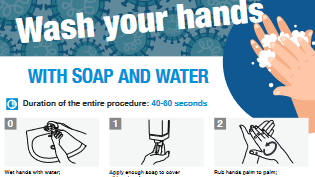
The hands constitute the main form of transmission of microorganisms during patient care. The skin is a possible reservoir for various microorganisms that can be transferred from one surface to another. The skin of the hands hosts two principal microorganism populations: those belonging to the resident microbiota and those belonging to transient microbiota. Transient microbiotas colonize the most superficial layer of the skin, which allows their mechanical removal by handwashing with water and soap, although they are eliminated more easily when an antiseptic solution is used. Typically, they include gram-negative bacteria such as enterobacteria (for example, Escherichia coli) and nonfermenting bacteria (for example, Pseudomonas aeruginosa), as well as fungi and viruses.
Handwashing is intended to remove visible dirt and transient flora, scaly cells, sweat, and skin oils. In addition, when combined with use of an antiseptic, it also helps decrease resident flora. In neonatology units for general care of newborns, either simple handwashing (with plain soap) or antiseptic handwashing (with soap containing antiseptic) is used. However, before using invasive procedures, surgical hand antisepsis is recommended. The use of detergent with antiseptic is also recommended for handwashing in units at greater risk for infection, for example, neonatal ICUs.